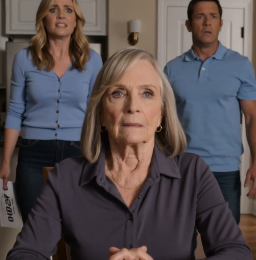
My DIL kicked me out of Thanksgiving: “You smell like onions again! Don’t come back!”. So I decided to get a train and go away. At the station, everyone mocked a deaf man, so I talked to him in sign language. I gave him my last $50. He signed: “You will have a good life”. At the next station… 6 men wearing black suits stopped me and said: “Ma’am, there’s someone that needs to show you some gratitude”…

I should have known something was wrong the moment Emory opened the door. Her smile was too bright, too practiced, like she’d been rehearsing it in the mirror.
She stood there in her perfectly pressed apron, not a hair out of place, looking like she’d stepped out of a magazine spread about perfect Thanksgiving hostesses.
“Geraldine,” she said, my name rolling off her tongue like something distasteful. “You’re here.” Not, “Happy Thanksgiving, Mom.” Or even, “Come in.” Just acknowledgement of my existence, delivered with the enthusiasm of someone greeting a door-to-d dooror salesman.
I clutched the small bouquet of supermarket flowers I’d brought, feeling suddenly foolish. $2347. That was what remained of my grocery budget for the week after buying those flowers. But I’d wanted to contribute something to the family gathering.
Something to show I belonged here, even if lately it felt like I didn’t. I brought these for the table, I said, offering the modest arrangement. Emry’s eyes flicked down to the flowers, and I caught the smallest curl of her lip before she composed herself.
How thoughtful, she said, taking them with the tips of her fingers as if they might contaminate her manicured hands.
Quincy’s in the kitchen. The house smelled like roasted turkey and sage, warm and inviting. But there was something else underneath, something cold that I couldn’t quite place.
As I followed Emory through the foyer, I noticed how everything gleamed. the hardwood floors, the granite countertops visible through the kitchen doorway, even the brass handles on the cabinets, this house that my son owned, this life he’d built, so different from the modest apartment where I’d raised him after his father died.
Quincy stood at the kitchen island, carving the turkey with surgical precision. At 44, he’d grown into a successful man.
His law practice was thriving. His house was beautiful. His wife was young and attractive, everything a mother should be proud of.
So why did I feel like a stranger in his home?
“Hi, honey,” I said, moving to give him a hug.
He stiffened slightly, but allowed the embrace, patting my back with the same enthusiasm he might show a distant acquaintance.
“Hey, Mom. Good to see you.”
The kitchen was filled with the sounds of a perfect Thanksgiving preparation. Pots bubbling on the stove, the oven timer beeping softly, the gentle clink of good china being arranged on the dining room table.
But underneath it all was silence. The kind that exists between people who have nothing real to say to each other.
“Can I help with anything?” I asked, looking around for some way to contribute.
Emory appeared beside us, having disposed of my flowers somewhere I couldn’t see.
“Oh no, everything’s under control. Why don’t you just sit?”
She gestured toward a bar stool at the far end of the kitchen island, the kind of seat you’d give someone you wanted to keep at a distance, but couldn’t completely exclude.
I perched on it awkwardly, my hands folded in my lap, watching my son and his wife move around each other in perfect choreographed harmony. They’d been married for 5 years now, and I still felt like an outsider looking in on their life.
Emory had made it clear from the beginning that she found my presence unnecessary, though she was always careful to couch her rejections in politeness.
Oh, Geraldine, you don’t need to come to Quincy’s birthday dinner. It’s just going to be very small. H, the holidays are so hectic. Maybe it’s better if you just relax at home this year.
But I was here now and I was determined to make the best of it.
“The turkey smells wonderful,” I said, trying to fill the silence.
“It should,” Emory replied, not looking up from the potatoes she was mashing. “It cost $68, organic, free range.”
There was something pointed about the way she said it, as if the price tag was meant to emphasize the distance between their world and mine. I thought of the $7 chicken I’d bought for my own Thanksgiving meal, the one I’d planned to eat alone in my efficiency apartment if they hadn’t invited me at the last minute.
“That’s nice,” I said quietly.
Quincy glanced up from his carving. “How’s the apartment, Mom? Everything working okay?”
“Oh, fine. The heat’s been a little spotty, but the landlord says he’ll look at it next week.”
I didn’t mention that I’d been sleeping with three blankets because I couldn’t afford to run the heating much or that the spotty heat was actually no heat at all and my landlord hadn’t returned my calls in 2 weeks.
“Maybe you should look for somewhere else,” Emory suggested, her voice casual. “Somewhere more suitable for someone your age.”
The way she said your age made me feel ancient. I was 69, not 99. I still worked part-time at the library, still lived independently, still had my health and my mind.
But in Emory’s tone, I heard the suggestion that I was already halfway to the grave.
I like my apartment, I said, though that wasn’t entirely true. What I liked was the independence it represented, the fact that I wasn’t a burden on anyone.
“Of course you do,” she said with that bright smile again.
The doorbell rang and Emy’s face lit up with genuine warmth for the first time since I’d arrived.
“That must be my parents,” she said, practically floating to the door.
“I’d forgotten that her parents were coming.” Charles and Patricia Morrison, who owned a chain of restaurants and spent their winters in Florida.
They swept into the house with expensive coats and loud voices, filling the space with the kind of energy that comes from never doubting your welcome anywhere.
Emory, darling, Patricia said, air kissing her daughter while somehow managing to embrace Quincy at the same time. The house looks absolutely divine.
Charles was already admiring something about the renovated kitchen, asking Quincy about the contractor and the cost of the marble countertops.
These were people who belonged in this house, who fit seamlessly into this life my son had built.
I remained perched on my bar stool, watching as the real family gathered, feeling more invisible by the moment.
“Mom,” Quincy said, suddenly remembering I existed. “You remember Emry’s parents.”
“Of course,” I said, standing to offer a polite greeting. “How nice to see you again.”
Patricia turned to me with the kind of smile people reserve for elderly relatives they see once a year and immediately forget.
Geraldine, wasn’t it? How lovely. You look well.
The pause before Well, said everything. I was wearing my best dress, the navy blue one I’d bought at a thrift store 3 years ago for church. But next to Patricia’s designer outfit, I felt shabby.
I could smell the department store perfume she wore, something expensive and floral, and became conscious of my own scent, soap, and the faint smell of onions from the chopping I’d done for my neighbor that morning to earn a few extra dollars.
Dinner was announced, and we moved to the dining room. The table was set for 6 with beautiful china and crystal glasses that caught the light from the chandelier overhead.
I found myself seated at the far end between Charles and an empty chair that would have been for Emory’s sister if she hadn’t cancelled at the last minute.
The conversation flowed around me like water around a stone. Talk of vacation plans and stock portfolios, of restaurants they’d tried and wines they’d discovered.
I tried to contribute when I could, but my stories of library patrons and thrift store finds seemed to fall flat, creating awkward pauses that Emory would quickly fill with a new topic.
I was reaching for the salt when it happened.
“Oh god,” Emory said suddenly, her voice sharp with disgust. “What is that smell?”
The table went quiet. Everyone’s heads turned, following Emy’s horrified gaze directly to me.
Emory, Quincy said quietly, a warning in his voice. But she was already standing, her hand pressed to her nose dramatically.
It’s onions. You smell like onions, Geraldine. It’s making me sick.
Heat flooded my cheeks. Yes, I’d chopped onions for Mrs. Rodriguez next door that morning because she had arthritis in her hands and couldn’t manage it herself.
She’d paid me $10 for the help, money I desperately needed. I’d scrubbed my hands afterward, used lemon juice and soap, but the smell must have lingered on my clothes.
“I’m sorry,” I whispered. “I didn’t realize.”
“How can you not realize?” Emry’s voice was getting louder, more shrill. “It’s overwhelming, Patricia. Aren’t you just dying from that smell?”
Patricia shifted uncomfortably in her seat, clearly torn between supporting her daughter and not wanting to be openly cruel to an elderly woman.
“I think I should go,” I said, starting to rise from my chair.
“Yes,” Emory said quickly, relief evident in her voice. “Yes, I think that would be best. This is a special dinner, and well, you understand.”
I looked at my son, waiting for him to defend me, to tell his wife that she was being cruel and unreasonable.
But Quincy just stared at his plate, his jaw tight, saying nothing.
“Quincy,” I said softly.
He finally looked up at me, and in his eyes, I saw something that cut deeper than his wife’s words.
“Embarrassment.”
He was embarrassed by me.
“Maybe it would be better, Mom,” he said quietly. just for tonight.
Those words hit me like a physical blow. My own son, the boy I’d raised alone after his father died, the one I’d worked three jobs to support through law school, was asking me to leave because I smelled like the honest work I’d done to survive.
I stood on shaking legs, my napkin falling to the floor. No one moved to help me pick it up.
I’ll get my coat, I managed to say.
In the foyer, I fumbled with my old wool coat, my hands trembling so badly I could barely manage the buttons. Through the dining room doorway, I could hear Emory’s voice, bright and cheerful again.
I’m so sorry about that. She’s been having some difficulties lately. Poor thing doesn’t really understand social cues anymore.
Poor thing. as if I were some adult old woman who couldn’t take care of herself instead of someone who’d sacrificed everything for the son who now sat silent while his wife humiliated me.
I let myself out without saying goodbye.
The November air hit my face like a slap, but I welcomed its honesty after the poisonous warmth inside.
In my car, I sat with my hands on the steering wheel trying to catch my breath.
$50.37.
That was all I had in my purse until my social security check came next week. Enough for gas and maybe a small dinner somewhere, but not enough for much else.
I pulled out of the driveway and drove toward downtown, not really knowing where I was going. The radio was playing soft jazz and the city lights blurred through my tears.
For the first time in my life, I had nowhere to go for Thanksgiving.
The train station appeared ahead of me. Its old brick facade lit up against the darkening sky. Without really deciding to, I pulled into the parking lot and sat there watching people hurry in and out with suitcases and purpose.
Maybe it was time to just go somewhere, anywhere. Leave this city where my son lived his perfect life without room for his embarrassing mother.
I had $50 and a credit card with maybe $200 of room left on it. enough for a train ticket to start over somewhere no one knew me.
For the first time all day, that thought didn’t make me sad. It made me feel almost free.
The train station at night had a different energy than during the day, where morning brought commuters rushing with purpose. Evening carried a slower, more melancholy rhythm.
People hugged goodbye, couples parted reluctantly, and travelers like me sat on benches with nowhere particular to go.
I’d been there for almost an hour just watching. The departure board flickered overhead showing trains to Chicago, New York, even one heading west to Denver.
All those possibilities, all those places where nobody knew that Geraldine Parker was the mother who embarrassed her successful son.
My $50 bill felt thin between my fingers. I’d counted it three times, hoping somehow it might multiply, but mathematics had never been magical.
$50.37, not enough for much of anywhere, but enough to disappear.
That’s when I noticed him.
He was sitting alone on a bench near the far wall. A older man, maybe in his 60s, dressed in a simple dark coat that had seen better years.
What caught my attention wasn’t his appearance, but the way other people reacted to him.
A young couple had been sitting beside him until he tried to ask them something, gesturing with his hands. They’d gotten up immediately and moved away, whispering to each other with disgusted looks.
A station employee had approached him twice, speaking loudly and slowly as if volume might overcome whatever communication barrier existed.
Each time the man had tried to respond with hand gestures, but the employee grew increasingly frustrated and eventually walked away, shaking his head.
I watched as a group of teenagers noticed him signing to himself, apparently talking through some internal conversation.
They started mimicking his hand movements, exaggerating the gestures and laughing.
Their cruel performance drew attention from other waiting passengers who either joined in the amusement or stared with uncomfortable fascination.
The man seemed to shrink into himself, his hands dropping to his lap as he became aware of the mockery, his shoulders curved inward, and even from across the waiting area, I could see the resignation in his posture.
He was used to this. Used to being treated like entertainment or an inconvenience.
Something hot and familiar stirred in my chest.
It was the same feeling I’d had watching neighborhood kids tease Mrs. Patterson when I was 25 and newly widowed. She’d lived in the apartment next to mine, a deaf woman in her 70s who’d never learned to speak clearly.
The children would shout at her and laugh when she couldn’t understand, making cruel jokes about her voice when she tried to respond.
I’d been the one to finally step in then, asking Mrs. Patterson to teach me sign language so I could help her communicate with landlords, doctors, and store clerks who didn’t have patience for written notes.
We’d spent hours together over the course of 2 years until she moved to live with her sister in Oregon. Those lessons had been a bright spot during the darkest period of my life when I was struggling to raise Quincy alone and feeling overwhelmed by everything.
I hadn’t used sign language in decades, but watching this man’s humiliation brought it rushing back.
Without really deciding to, I stood up and walked across the waiting area. The teenagers scattered as I approached, probably sensing they were about to be scolded by someone’s grandmother.
The man looked up as I sat down beside him, weariness in his dark eyes. I lifted my hands slowly and signed, “Are you okay?”
The change in his expression was immediate and profound. His eyes widened, then filled with something that might have been relief or gratitude or both.
He straightened in his seat, no longer trying to make himself invisible.
You know, sign, he signed back, his movements quick and fluid, much more confident than my rusty attempts.
A little, I replied, struggling to remember the right hand shapes. People were being unkind. I’m sorry.
He waved away my apology with a graceful gesture.
I’m used to it. Thank you for noticing, though. Not many people do.
We sat in comfortable silence for a moment, and I found myself studying his face. There was something dignified about him, despite his simple clothes and the way others had treated him.
His hands were clean and well cared for, his posture straight now that he didn’t feel under attack. He carried himself like someone accustomed to respect, even if he wasn’t receiving it tonight.
“Are you traveling?” I asked.
“Supposed to be?” he signed, then paused. “But I think I lost my wallet, had my ticket, my identification, everything.”
My heart sank for him. Being stranded was bad enough when you could easily communicate with station personnel. For someone who couldn’t hear and relied on sign language, it would be nearly impossible to get help from anyone here.
Did you check the lost and found?
He nodded, looking discouraged.
The clerk couldn’t understand what I was looking for. He kept talking louder as if that would help.
His hands moved with a touch of bitter humor.
Amazing how many people think deafness is actually a volume problem.
I found myself smiling at that which seemed to surprise him.
Where were you trying to go? I asked.
Baltimore. I have family there.
He paused, seeming to debate something with himself.
I’m supposed to be at work tomorrow, but I guess that’s not happening now.
What kind of work do you do?
His hands hesitated. Then he signed simply medical field, but it’s not important now.
There was something he wasn’t telling me, but I didn’t press. We all had our private troubles.
I looked around the station at all the people rushing past without a second glance at this man who was stuck.
The departure board showed a train to Baltimore leaving in 45 minutes.
According to the price display, a one-way ticket cost $43.
I had $50.37.
What if I bought your ticket? I heard myself asking.
His hands went still.
I couldn’t ask you to do that.
You didn’t ask. I’m offering.
You don’t even know me.
I thought about that for a moment.
I know you’re stranded and need help. I know people were treating you badly and you didn’t respond with anger.
That tells me enough.
He studied my face intently as if trying to read something there.
Why would you help a stranger?
The question caught me off guard. Why was I willing to give away almost all the money I had to someone I’d just met?
Maybe it was because I’d been shown so little kindness myself today. Maybe it was because helping Mrs. Patterson had been one of the few times in my life I’d felt truly useful.
Or maybe it was simply because doing something good felt better than sitting alone feeling sorry for myself.
because you need help and I can provide it,” I signed. “It’s that simple.”
He was quiet for a long moment, his hands folded in his lap.
When he finally looked up, his eyes were bright with unshed tears.
“That would mean everything to me,” he signed. “But I don’t know how I could repay you.”
You don’t need to repay me.
I stood up and walked to the ticket counter, my heart pounding. $43 would leave me with $7.37, not enough to buy a ticket anywhere myself, barely enough for a meal.
But seeing the relief and gratitude in his expression, had been worth more than money.
The ticket agent, a tired looking woman in her 40s, barely looked up as she processed the purchase.
“Next train to Baltimore departs platform 3 in 40 minutes,” she said, sliding the ticket across the counter.
When I returned to the bench, he was standing ready to go.
I handed him the ticket and he stared at it for a moment as if he couldn’t quite believe it was real.
“Thank you,” he signed, but the simple words seemed inadequate for what he was feeling.
“Travel safely,” I replied.
He hesitated, then reached into his coat pocket and pulled out a business card.
It was plain white with just a phone number printed on it, no name or company. He pressed it into my hand.
“If you ever need anything,” he signed. “Call this number. Tell them Samuel sent you.”
“Samuel,” I repeated, trying to remember the sign for his name.
He showed me, spelling it out with finger letters, then making a quick gestural sign that looked like he was drawing something in the air.
“What will I tell them you did for me?” I asked.
His hands moved slowly, thoughtfully.
“Tell them you showed kindness to a stranger when no one else would. They’ll understand.”
There was something significant about the way he said it, as if this card and this number meant more than they appeared to.
But before I could ask, the announcement came over the loudspeaker for final boarding to Baltimore.
“That’s my train,” he signed.
“Go,” I urged him. “Don’t miss it.”
He picked up a small canvas bag I hadn’t noticed before and slung it over his shoulder.
As he started to walk away, he turned back one more time.
“You will have a good life,” he signed.
The movements deliberate and precise. “It didn’t feel like a casual wish or empty platitude. It felt like a promise.”
Then he disappeared into the crowd heading toward platform 3.
I sat back down on the bench, the business card still warm in my palm. Around me, the station continued its evening rhythm.
But something had shifted. The emptiness I’d felt leaving my son’s house had been replaced by something else.
Not happiness exactly, but a sense of having done something meaningful.
$7.37.
I counted the remaining money in my purse and laughed quietly to myself. I’d given away most of what I had to a complete stranger, and somehow I felt richer than I had all day.
The card was plain and unremarkable, but I slipped it carefully into my wallet next to my driver’s license.
Samuel had said to call if I ever needed anything, but what could a deaf man with no wallet possibly do to help someone like me?
Still, there had been something in his manner, in the way he’d signed that final promise, that made me think there was more to Samuel than met the eye.
I looked up at the departure board again. The train to Baltimore was probably pulling out of the station now, carrying Samuel toward whatever family was waiting for him.
I hoped they would appreciate what he’d gone through to get there, the kindness of strangers that had made his journey possible.
A new announcement echoed through the station, calling for passengers to board the late train to Chicago.
For a moment, I considered it. $7 wouldn’t buy me a ticket, but maybe I could talk to the conductor, explain my situation.
Maybe there was a way to start over somewhere new.
But as I sat there in the warm station, watching other people begin their journeys, I realized something had changed in me.
For the first time in months, I didn’t feel like running away. I felt like someone who had something valuable to offer the world, even if my own family couldn’t see it.
I stood up, gathered my coat, and walked toward the exit.
Outside, the November air was still cold, but it no longer felt like a slap. It felt like a fresh start.
The business card pressed against my fingers through my wallet as I walked to my car.
Samuel had disappeared into the night, but he’d left me with something unexpected.
Not just a mysterious phone number, but a reminder that there were still people in the world who recognized genuine kindness when they saw it.
And somehow that felt like the beginning of something important.
I made it exactly three blocks from the train station before they found me.
Six men in identical black suits materialized from the shadows like something out of a movie.
They moved with the kind of coordinated precision that spoke of military training or law enforcement, forming a loose circle around my old Honda.
As I sat at a red light, my first instinct was panic. In my neighborhood, well-dressed men approaching your car at night usually meant trouble of the expensive kind.
I fumbled for the door lock, but the man nearest my window held up his hands in a gesture of peace.
He was tall, maybe in his 40s, with graying temples and the kind of serious expression that comes from carrying important responsibilities.
When he spoke, his voice was respectful but urgent.
Mrs. Parker, I’m Agent Morrison with hospital security. There’s someone who needs to show you some gratitude.
Hospital security?
I rolled down my window a few inches, my heart still hammering.
I don’t understand.
The gentleman you helped at the train station tonight, Dr. Samuel Chen. He asked us to find you.
Dr. Chen.
Samuel was a doctor.
That explained the dignity I’d sensed beneath his simple clothes, but it didn’t explain why hospital security was tracking me down like I was some kind of fugitive.
“Is he okay?” I asked. “Did something happen to his train?”
Agent Morrison exchanged glances with his colleagues.
“Mrs. Parker, would you be willing to come with us? Dr. Chen would very much like to speak with you, and there are some things he needs to explain in person.”
Every instinct I’d developed in 69 years of life told me to drive away.
Normal people didn’t get approached by teams of security agents. Normal good deeds didn’t result in mysterious summons in the middle of the night.
But nothing about this evening had been normal. starting with my own son asking me to leave his Thanksgiving table.
And something in Agent Morrison’s manner convinced me that whatever this was about, it wasn’t dangerous. At least not to me.
Where is Dr. Chen? I asked.
St. Mary’s Hospital about 15 minutes from here.
I thought of my empty apartment, of the $7.37 in my purse, of the humiliation still burning in my chest from dinner.
What did I have to lose?
I’ll follow you, I said.
The convoy of black SUVs that escorted me through the city was both ridiculous and oddly comforting.
Whatever Samuel had gotten himself into, it was clearly serious enough to warrant this level of security.
As we pulled into the hospital’s private entrance, I began to understand that the man I’d helped wasn’t just any doctor.
St. Mary’s was the kind of hospital where wealthy people went for discrete treatment.
The private wing we entered looked more like a luxury hotel than a medical facility with marble floors and original artwork on the walls.
Agent Morrison guided me through corridors that smelled of expensive disinfectant and privilege.
Mrs. Parker, he said as we walked, before we go in, I need to explain something.
Doctor Chen suffered a massive heart attack at the train station tonight. If you hadn’t been there to communicate with the paramedics, he would have died.
The words hit me like a physical blow.
Heart attack, but he seemed fine when I talked to him.
He was having chest pains when you found him. That’s why he was sitting alone trying to manage the discomfort.
When the attack intensified, he tried to signal for help, but nobody understood what he needed. You saved his life by translating for the emergency responders.
I stopped walking.
I didn’t translate for anyone. I just bought him a train ticket.
Agent Morrison looked confused.
Mrs. Parker, the paramedics reported that a woman used sign language to communicate Dr. Chen’s symptoms and medical history. That information was crucial for his treatment.
My memory of the evening suddenly shifted, pieces falling into place differently.
The moment when Samuel had tried to ask those people something and they’d moved away in disgust. The way he gestured when the station employee couldn’t understand him. The teenagers mocking his hand movements.
“Oh my god,” I whispered. “He wasn’t trying to travel. He was trying to get help.”
“The Baltimore story was a cover,” Agent Morrison confirmed gently. “Dr. Chen is very private about his medical conditions. He didn’t want to alarm you or make you feel obligated to help. But when he realized he was having a heart attack, he tried to communicate his symptoms to passers by. You were the only one who understood.”
The corridor seemed to tilt around me. I’d thought I was doing a simple kindness for a stranded traveler.
Instead, I’d apparently saved someone’s life without even realizing it.
“Is he going to be okay?” I asked.
“Thanks to you, yes. The doctors were able to treat him immediately because they knew exactly what was happening. A few more minutes of delay and—”
Agent Morrison didn’t finish the sentence.
We stopped in front of a heavy wooden door marked private suite.
Agent Morrison knocked softly, then opened it to reveal a spacious room that looked nothing like any hospital room I’d ever seen.
Samuel was sitting up in bed, connected to various monitoring devices, but looking alert and much healthier than someone who just survived a heart attack.
“Geraldine,” he said aloud, his voice clear and strong. “Thank you for coming.”
I stared at him in shock.
“You can speak.”
He smiled, the expression that transformed his entire face.
“I’ve been deaf since birth, but I learned to speak in my 20s. I don’t use my voice often in public because people react strangely to deaf accents. It’s easier to let them assume I can’t talk.”
The revelation was disorienting.
Everything I’d thought I understood about our encounter was wrong.
But the train ticket was an incredibly generous gift from someone who thought I needed help traveling.
His voice carried deep emotion.
You gave me $43 when you only had 50. I saw you counting your money, Geraldine. I know what that sacrifice meant.
Heat flooded my cheeks.
It wasn’t that much. Anyone would have done the same.
No, Samuel said firmly. They wouldn’t have.
I sat in that station for 2 hours watching people ignore my distress. You were the only one who saw past my disability to recognize my humanity.
And when you thought I was stranded, you gave away almost everything you had to help me.
I moved closer to his bed, still struggling to process everything.
The business card you gave me is my direct line.
Geraldine, I need to ask you something important. Has anyone in your family ever mentioned my name, Dr. Samuel Chen? Possibly in connection with legal matters.
The questions seem to come from nowhere.
legal matters?
No, I don’t think so. Why would they?
Samuel exchanged a meaningful look with Agent Morrison.
What do you know about your son’s law practice?
A chill ran down my spine.
Quincy specializes in estate planning, elder law, mostly. He helps families with inheritance issues, and I trailed off, sensing somehow that I was about to learn something terrible.
Geraldine Samuel said gently, “Your son has been stealing from his elderly clients for over 3 years. My hospital has been investigating him because several of our patients families came to us with complaints about missing inheritance money.”
The world tilted sideways.
“That’s impossible. Quincy would never. He’s a respected attorney. He has ethics rules, professional standards.”
“He’s very careful,” Agent Morrison said quietly. He targets elderly clients who don’t have close family oversight, people who trust him completely and don’t question his handling of their affairs.
Samuel leaned forward in his bed, his expression compassionate but serious.
I’ve been working with law enforcement for months documenting his crimes. We have evidence of him stealing from at least 12 different clients totaling over $800,000.
No, I said, shaking my head. You’re wrong. You must be wrong.
Geraldine, Samuel said softly. When did you stop receiving your inheritance payments?
My blood turned to ice.
What inheritance payments?
From your husband’s life insurance policy. Robert Parker had a substantial term life policy that was set up to provide monthly payments to you for 20 years after his death. Those payments should have continued until 2015.
I sank into the chair beside his bed, my legs no longer able to support me.
I never received any inheritance payments. Robert’s policy barely covered his funeral expenses.
Samuel’s face was grave.
According to the insurance company’s records, monthly payments of $1,400 have been going to an account managed by Quincy Parker, acting as your financial guardian since 2003.
$1,400 every month for 20 years.
The numbers swam in my head, too large and terrible to comprehend.
$340,000.
Money that should have kept me comfortable. That should have meant I never had to choose between heat and groceries. Never had to chop onions for neighbors to earn $10.
That’s impossible, I whispered. I would have known. There would have been paperwork.
Your son filed guardianship papers after your husband died. Agent Morrison explained. He claimed you were suffering from grief related depression and couldn’t manage your own finances.
The insurance company sent all correspondents directly to him.
I remembered those months after Robert’s death. I had been devastated, overwhelmed by trying to raise Quincy alone while grieving the loss of my partner.
Quincy had been 16, old enough to help with some arrangements, but young enough to need guidance.
I’d been grateful when he’d taken initiative with some of the legal paperwork, proud of how mature and responsible he was being.
He’d stolen from me for 20 years. started when he was still in high school, continued through college, law school, his wedding, his entire adult life.
Every time I’d struggled to pay rent, every time I’d apologized for not being able to help him financially, he’d been living off money that belonged to me.
“The insurance company tried to contact you several times over the years when payments were missed or delayed,” Samuel continued. “But Quincy intercepted all the correspondence. As far as they knew, you were being taken care of.”
My mind flashed to all the times Quincy had handled my mail, offering to help with bills and paperwork because it was too much stress for me.
Times when I’d been grateful for his assistance, proud that I’d raised such a caring son.
“Does Emory know?” I asked, though I already suspected the answer.
Samuel nodded grimly.
She’s the one who suggested the guardianship fraud originally. We have emails between them discussing how to maintain the arrangement and avoid detection.
Emory, the woman who’d humiliated me for smelling like onions, who’d treated me like an unwelcome burden, had been living in a house paid for with money stolen from me.
The expensive furniture, the $68 turkey, the renovated kitchen with marble countertops, all of it funded by my husband’s life insurance.
“Why are you telling me this?” I asked. “Why do you care about one old woman’s family problems?”
“Because you saved my life,” Samuel said simply. “And because I’ve spent my career fighting for people who can’t fight for themselves. I run a foundation that provides legal aid to elderly victims of financial abuse. When I started investigating your son, I never imagined I’d end up owing my life to his victim.”
The irony was breathtaking.
The son who’d stolen my future had led me to the man who could restore it. The humiliation that had driven me from Quincy’s house had brought me to the train station at exactly the moment Samuel needed help.
“What happens now?” I asked.
Now we give you back what was stolen, Samuel said. And we make sure your son faces consequences for what he’s done.
Agent Morrison pulled out a thick folder.
We have all the documentation ready. The insurance company has already frozen your son’s access to the accounts. You can have your money back by the end of the week.
$340,000.
The amount was so large it felt abstract, like monopoly money. But it represented 20 years of struggling, 20 years of believing I was a burden, 20 years of accepting charity from the very people who were robbing me.
There’s something else, Samuel said quietly.
The medical emergency tonight, your intervention, it’s given us the perfect opportunity to approach your son about the investigation. We’d like you to be there when we do.
I looked up at him sharply.
What do you mean?
We mean, Agent Morrison said with a slight smile.
That Quincy Parker is about to learn that the mother he dismissed tonight holds all the power in his life.
As the full implications sank in, I felt something I hadn’t experienced in decades.
Not just relief or vindication, but a sense of justice so profound it made me dizzy.
Tomorrow, the son who’d asked me to leave his table because I embarrassed him would discover that his entire comfortable life had been built on money stolen from the woman he’d rejected.
I didn’t sleep that night. How could I?
20 years of lies had been stripped away in a single conversation, leaving me staring at the ceiling of my efficiency apartment with a clarity that was almost painful.
Samuel had sent me home with a thick folder of documents and Agent Morrison’s business card, promising they would contact me the next morning with a plan.
But lying there in the dark, listening to my neighbors television through the thin walls, I found myself thinking about more than just the money.
I thought about every time I’d apologized for not contributing more to family gatherings.
every birthday when I’d given Quincy a modest gift and watched him accept it with the kind of polite gratitude you show to distant relatives.
Every Christmas when Emory had made subtle comments about how difficult it must be to live on a fixed income.
They had been stealing from me while accepting my gratitude for their occasional acts of charity.
The phone rang at exactly 8:00 in the morning. Agent Morrison’s voice was crisp and professional.
Mrs. Parker, Dr. Chen would like to meet with you this morning before we approach your son. Are you available at 10:00?
I was dressed and ready by 9:30, sitting in my car outside St. Mary’s Hospital with the folder of evidence in my lap.
The November morning was gray and cold, matching my mood perfectly.
Today, my son was going to learn that his entire adult life had been built on a foundation of theft and lies.
The question was, “What did I want to happen to him?”
Samuel looked much better when I arrived at his room. The monitors were gone, and he was dressed in street clothes, sitting in a chair by the window with a cup of coffee.
When he saw me, he stood and embraced me gently.
“How are you feeling?” he asked.
“Angry,” I said honestly. “Confused, betrayed, but also relieved somehow. At least now I know why nothing ever made sense.”
He nodded understanding.
Financial abuse within families is particularly devastating because it destroys trust in the people who are supposed to protect you. Your feelings are completely normal.
What happens to Quincy? I asked. If we proceed with this investigation, what are the consequences?
Samuel’s expression grew serious.
That depends partly on you. We have enough evidence to pursue criminal charges for fraud, elder abuse, and embezzlement.
If convicted, he could face 5 to 10 years in prison, and be required to repay everything he’s stolen, plus penalties.
And if I don’t want to press charges?
We can still recover your money through civil proceedings. The insurance company is eager to cooperate because they’ve been defrauded, too.
But without criminal charges, Quincy might only face professional consequences.
Loss of his law license, civil penalties.
I stared out the hospital window at the city below.
Somewhere out there, my son was probably having his morning coffee, preparing for another day of practicing law, completely unaware that his world was about to collapse.
There’s something else you should know, Samuel said quietly.
We’ve been monitoring his communications since we started the investigation.
Yesterday, after you left his house, Quincy called his office partner to discuss what he called the mother problem.
My stomach clenched.
What did he say?
Samuel pulled out a small recording device.
Are you sure you want to hear this?
I nodded, though my hands were shaking.
The recording quality was crystal clear.
Quincy’s voice, confident and casual, discussing me like I was a business obstacle.
She’s getting more difficult, I heard him say. Emory thinks we should look into assisted living options, something to limit her access to family functions.
Another voice, his partner, David.
That seems harsh. She’s still mentally competent, right?
Physically, yes. But she’s becoming an embarrassment. Did you see how she showed up to Thanksgiving?
She smelled like she’d been working in a restaurant kitchen. Emory was mortified in front of her parents.
My breath caught.
He’d been planning to institutionalize me.
The financial guardianship makes it easier. Quincy continued. I can argue that she’s not capable of managing her living situation independently.
The smell, the inappropriate behavior, the inability to maintain proper hygiene standards. It all builds a case for incompetence.
David’s voice was uncomfortable.
Quincy, that sounds like you’re manufacturing evidence.
I’m documenting a natural decline. It happens to everyone eventually. Better to handle it proactively than wait for a crisis.
What about her own wishes?
Quincy laughed. A sound I’d heard countless times, but never recognized as cruel until now.
David. She’s living in a studio apartment and chopping onions for neighbors to earn grocery money.
Trust me, assisted living would be an upgrade. She’ll thank us eventually.
The recording ended.
Samuel watched my face carefully as he put the device away.
They weren’t just stealing my money, I said slowly. They were planning to take away my freedom.
The financial abuse was phase one, Samuel [clears throat] confirmed.
Complete control of your living situation would have been phase two.
Once they had you in a facility they selected, they could have managed every aspect of your life while continuing to collect your benefits.
The full scope of their betrayal hit me like a physical blow.
This wasn’t just about greed. They had been systematically destroying my independence, my dignity, my sense of reality itself.
Every time I’d struggled financially and they’d offered small helps. $20 here, a meal there.
They’d been reinforcing my dependence while stealing hundreds of times that amount.
How long have you been investigating Quincy? I asked.
8 months.
It started when Mrs. Elellanar Hartwell came to our patient advocacy office. Her grandson brought her in because she suspected her attorney was stealing from her trust fund.
When we started looking into her case, we found a pattern.
Samuel opened another folder. This one filled with photographs of elderly faces.
Men and women in their 70s and 80s, all looking proud and dignified in their professional head shot.
12 victims so far, he said. All clients of your son’s firm, all elderly, all either widowed or isolated from family.
Your son was very careful about target selection.
I studied the faces, seeing myself reflected in their vulnerability.
What happened to them?
Mrs. Hartwell lost $63,000 from her trust fund before her grandson intervened.
Mr. Peterson lost his entire inheritance from his wife’s estate, nearly $200,000.
Mrs. Chen, Chen, are you related?
Samuel’s expression darkened.
My aunt, she lost $120,000 before she died. That’s when I got personally involved in this investigation.
The revelation added another layer to an already complex situation.
Samuel wasn’t just a good Samaritan I’d helped at a train station. He was a man whose family had been victimized by my son, who had been working for months to bring Quincy to justice.
“You knew who I was last night,” I said. at the train station.
I suspected when you told me your last name was Parker, it seemed too coincidental, but I wasn’t certain until Agent Morrison confirmed your identity.
So, when you said I would have a good life, I meant it.
Your son’s crimes were about to be exposed whether we’d met or not. You saved my life, Geraldine.
The least I could do was make sure justice included you.
A knock at the door interrupted us.
Agent Morrison entered, followed by a woman in a expensive suit carrying a briefcase.
Mrs. Parker, Agent Morrison said, this is Attorney General Richards. She’s here to discuss your options.
Attorney General Richards was probably in her 50s with the kind of authoritative presence that came from years of prosecuting difficult cases.
She shook my hand firmly and sat down across from me.
Mrs. Parker, I want you to know that what happened to you represents one of the most extensive cases of familial financial abuse we’ve seen.
Your son didn’t just steal money.
He systematically manipulated your understanding of your own financial situation to maintain control over your life.
What are my choices? I asked.
We can proceed with criminal charges immediately. The evidence is overwhelming and we can guarantee conviction.
Your son would face significant prison time and be required to make full restitution.
And if I don’t want to pursue criminal charges?
We can still recover your money through civil proceedings and professional sanctions. Your son would lose his law license and be barred from practicing law, but he wouldn’t face jail time.
I thought about the recording, about Quincy’s casual discussion of putting me in assisted living against my will, about Emory’s cruel smile as she humiliated me in front of her parents, about 20 years of believing I was a burden when I was actually being robbed.
There’s a third option, Attorney General Richards continued.
We can arrange a confrontation where your son learns about the investigation in your presence. Sometimes seeing the human cost of their crimes helps defendants understand the gravity of their actions.
You mean I could be there when you tell him you know what he’s done?
Yes. Dr. Chen suggested it might provide some closure for you to see your son’s reaction when he learns his crimes have been discovered.
I thought about Quincy asking me to leave his table because I embarrassed him.
About Emory’s disgust at my smell. about their plans to institutionalize me for being inconvenient.
“I want to be there,” I said. “I want to see his face when he realizes the mother he dismissed controls his entire future.”
Attorney General Richards smiled grimly.
“Then let’s pay your son a visit.”
As we prepared to leave the hospital, Samuel took my arm gently.
“Geraldine,” he said. Whatever you decide about pressing charges, remember that you have your power back now.
You’re not the victim anymore. You’re the one making the choices.
For the first time in 20 years, that felt absolutely true.
The drive to Quincy’s law office took 25 minutes, giving me plenty of time to think about what I wanted to say to the son who had stolen my life while pretending to love me.
By the time we pulled into the parking lot of his prestigious downtown firm, I knew exactly what kind of justice I wanted.
Quincy’s law office was everything I’d expected and nothing I’d ever felt comfortable in.
Glass and steel, polished marble, abstract art that probably cost more than I’d spent on rent in 2 years.
The kind of place designed to intimidate clients into believing their attorney was worth his astronomical fees.
I’d been in this building exactly twice in the 20 years since Quincy had established his practice.
Both times, I’d felt like an intruder, someone who clearly didn’t belong among the wealthy clients who could afford his services.
Now, walking through the lobby flanked by Agent Morrison and Attorney General Richards, I felt different.
Not like an intruder, but like someone with a purpose.
He’s in a client meeting, the receptionist informed us, her voice carefully neutral despite the obvious tension of having law enforcement appear unannounced.
Mr. Parker asked not to be disturbed.
“Tell him it’s about his mother,” Attorney General Richards said calmly. “Tell him it’s urgent.”
The young woman’s eyes flicked to me, taking in my modest coat and sensible shoes, clearly confused about why this elderly woman was accompanied by what was obviously a very serious legal delegation.
She picked up her phone and spoke in hushed tones.
Hell see you in 5 minutes, she said, hanging up.
Conference room B.
As we waited, I studied the photographs lining the walls.
Quincy shaking hands with judges, receiving awards from bar associations, posing at charity functions with Emory by his side.
In every picture, he looked confident, successful, respected, the kind of son any mother should be proud of.
I thought about the recording Samuel had played me, about Quincy’s casual discussion of putting me in assisted living against my will, about how he’d laughed when his partner suggested I might have my own wishes about my living situation.
Mrs. Parker, Attorney General Richard said quietly, “Are you ready for this?”
I nodded, though my hands were shaking slightly.
I’ve been ready for 20 years. I just didn’t know it.
The conference room was impressive with floor to ceiling windows overlooking the city and a table that could seat 20 people.
Quincy was already there when we entered, standing at the head of the table in his perfectly pressed suit, his expression shifting from professional courtesy to confusion to alarm as he registered who was with me.
“Mom,” he said, his voice carefully controlled. “What’s going on? These people said it was urgent.”
Hello, Quincy,” I said, surprised by how calm my own voice sounded.
We need to talk.
Attorney General Richards took charge immediately, placing her briefcase on the conference table and removing several thick folders.
Mr. Parker, I’m Attorney General Richards. This is Agent Morrison from the Hospital Fraud Investigation Unit.
We’re here about your handling of your mother’s financial affairs.
The color drained from Quincy’s face, but he recovered quickly, slipping into lawyer mode.
“I don’t understand what financial affairs. My mother handles her own finances.”
“Actually,” Agent Morrison said, consulting his notes. “According to our records, you’ve been managing her finances under a guardianship arrangement since 2003.”
An arrangement that has allowed you to intercept and redirect monthly insurance payments totaling $340,000 over the past 20 years.
Quincy’s carefully composed expression cracked just for a moment before he reassembled his professional mask.
I think there’s been some misunderstanding.
My mother asked me to help with paperwork after my father died.
Everything I’ve done has been with her knowledge and consent.
Is that true, Mrs. Parker. Attorney General Richards asked me directly.
I looked at my son, this man I’d raised alone after his father died. This person I’d been so proud of for his success and accomplishments.
No, I said clearly. It’s not true.
I never asked you to manage my finances.
I never knew there were any insurance payments.
I never knew about any guardianship arrangement.
Quincy turned to me, his eyes flashing with something between anger and desperation.
Mom, you were grieving. You couldn’t handle the paperwork. I was trying to help you by stealing from me.
The word hung in the air like an accusation that could never be taken back.
Quincy flinched as if I’d slapped him.
I didn’t steal anything, he said, his voice rising slightly. I invested your money.
I’ve been managing it responsibly.
You think that little apartment you live in is cheap? You think your bills pay themselves?
I’ve been supplementing your income for years.
The audacity of it took my breath away.
He was actually trying to make me grateful for his theft, pretending that his occasional $20 handouts were acts of generosity rather than crumbs from my own stolen inheritance.
supplementing my income with my own money, I said.
Money that belonged to me from the beginning.
Agent Morrison spread documents across the table.
Mr. Parker, we have bank records showing monthly deposits of $1,400 from Hartwell Insurance Company into accounts controlled by you.
We have correspondence showing that these payments were designated for your mother’s care and maintenance.
We have evidence that she received none of these funds.
Quincy stared at the papers, his jaw working silently.
I could see him calculating, trying to find a legal angle, some way to make this disappear.
There are also the other clients. Attorney General Richards continued.
Mrs. Elellanar Hartwell, Mr. James Peterson, Mrs. Linda Chen, 12 elderly clients whose trust funds and inheritances you’ve systematically depleted over the past 3 years.
What?
That’s completely different, Quincy snapped.
Those are complex estate management situations. You can’t just look at numbers on a page and assume.
We can when the numbers show consistent patterns of unauthorized withdrawals and fabricated expenses. Agent Morrison interrupted.
We’ve been building this case for 8 months, Mr. Parker.
We have everything.
I watched my son’s face as the reality of his situation sank in.
The confident attorney disappeared, replaced by someone who looked suddenly young and frightened.
For a moment, I almost felt sorry for him.
Then I remembered the recording.
“Quincy,” I said quietly. “Yesterday at dinner, after you asked me to leave because I embarrassed you, what did you do?”
He looked confused by the change of topic.
“What do you mean? Did you call your office? Did you talk to David about me?”
The confusion in his eyes shifted to weariness, then to something approaching panic.
How do you know about that?
Attorney General Richards pulled out the small recording device.
Would you like to hear it?
No, Quincy said quickly. You can’t use that. Attorney client privilege.
Your partner isn’t your client, Mr. Parker.
And discussing plans to institutionalize your mother against her will isn’t protected communication.
She pressed play.
My son’s voice filled the conference room, casual and confident as he discussed my supposed decline, my embarrassing behavior, the need to manage the mother problem by putting me in assisted living.
His laughter when his partner suggested I might have my own wishes about my living situation.
As the recording played, I watched Quincy’s expression change from defiance to horror to resignation.
He knew he was caught not just in financial fraud, but in his complete disregard for my humanity.
When the recording ended, the silence stretched until it became unbearable.
Mom, Quincy said finally, his voice small.
I can explain.
Explain what? I asked.
Explain how you’ve been stealing from me since you were 16.
Explain how you plan to put me in a facility against my will.
Explain how you laughed about my wishes not mattering.
I was trying to take care of you by taking away my freedom. By making me think I was a burden when you were living off money that belonged to me?
Quincy’s composure finally cracked completely.
Do you have any idea how hard it’s been having a mother who works part-time at a library, who lives in a studio apartment, who shows up to family dinners smelling like other people’s kitchens?
Do you know what that’s like for someone in my position?
The honesty was more devastating than any lie could have been.
This wasn’t about protecting me or helping me.
This was about his embarrassment at having a mother who didn’t fit his image of success.
You could have helped me with the money that was already mine.
I said, “You could have made sure I lived comfortably instead of stealing from me and then being ashamed of the poverty you created.”
I didn’t create anything.” Quincy shot back, his anger overriding his judgment.
You chose to live like that. Even with the money I was managing, you could have asked for more help.
You could have lived better.
Asked who?
You never told me there was money to ask for.
Attorney General Richards stood up.
Mr. Parker, you have two choices.
You can cooperate with this investigation and work toward a settlement that includes full restitution and professional sanctions, or we can proceed directly to criminal charges for elder abuse, fraud, and embezzlement.
Quincy looked at her, then at Agent Morrison, then at me.
For the first time in my adult life, I saw my son not as the successful attorney or the ungrateful child, but as what he really was, a weak man who had built his life on theft and lies.
“What do you want from me?” he asked.
And I wasn’t sure if he was talking to the investigators or to me.
“I want my money back,” I said. “All of it. I want you to face consequences for what you’ve done. and I want you to understand that the mother you were ashamed of is the reason you’re not going to prison.”
He looked confused.
What do you mean?
Attorney General Richard smiled grimly.
Your mother saved the life of Dr. Samuel Chen last night.
Dr. Chen runs the foundation that’s been investigating your crimes.
Because of her actions, he’s recommended that we offer you a plea agreement instead of pursuing maximum criminal penalties.
The irony was so perfect it was almost funny.
The same night Quincy had rejected me for embarrassing him, I had unknowingly saved the life of the man who could destroy his career.
The kindness he found shameful had earned him the mercy he didn’t deserve.
“I don’t understand,” Quincy said weakly.
“You don’t have to understand,” I replied, standing up from my chair. “You just have to live with the consequences of your choices.”
I looked at my son one last time, this man I had raised and loved and sacrificed for, who had repaid me with theft and betrayal and plans to steal my freedom.
“Goodbye, Quincy,” I said. “Don’t contact me again.”
As I walked toward the door, I heard him call my name, his voice breaking.
I didn’t turn around.
Some relationships once broken by betrayal this profound can never be repaired.
And for the first time in my life, I was okay with that.
Two years later, I stood in the kitchen of my new apartment making coffee and watching the sunrise through windows that faced east instead of the brick wall I’d stared at for so many years.
The apartment had two bedrooms, central heating that worked, and a view of the park where I took my morning walks.
The insurance settlement had been finalized within 6 weeks of the confrontation.
$340,000 plus interest and penalties had been transferred to accounts in my name only.
Quincy had been disbarred and sentenced to 18 months in minimum security prison, followed by 5 years of probation and community service working with elderly fraud victims.
Emory had filed for divorce before his sentencing hearing was even completed.
I could have bought a house with the settlement money.
I could have traveled the world, purchased a luxury car, or moved to Florida like so many people my age.
Instead, I’d chosen to live simply and invest wisely, keeping enough to ensure my comfort while using the rest to make sure I never had to depend on anyone again.
The phone rang as I was reading the morning paper, a luxury I’d never been able to afford when $50 had to last a week.
Good morning, Geraldine.
Samuel’s voice was warm and familiar.
“How are you feeling today?”
“Free,” I said, the same answer I’d given him every time he’d asked that question for the past two years.
Samuel and I had developed an unlikely friendship after the investigation concluded.
He’d insisted on staying in touch, claiming that saving his life had created a bond between us that couldn’t be broken by the resolution of legal proceedings.
I suspected it was more than that. two people who had survived betrayal by people they’ trusted, who understood the particular kind of strength required to rebuild after profound loss.
“Are you ready for today?” he asked.
“Today was special.”
Quincy was being released from prison, and according to the terms of his probation, he was required to attend a victim impact session where the people he’d stolen from could address him directly if they chose to.
I was the only victim who had agreed to participate.
I’m ready, I said.
Are you coming?
I’ll be there. Moral support.
The community center where the session was being held looked like countless other institutional buildings.
Bland, functional, designed to be as non-threatening as possible.
I arrived early and sat in the parking lot for a few minutes, thinking about what I wanted to say to the son I hadn’t spoken to in 2 years.
I’d received letters from him during his incarceration. not many, and I’d only read the first one.
It had been filled with self-pity and justifications, complaints about prison conditions and protests that he’d been trying to help me all along.
I’d stopped reading and donated the rest to the shredder, but I’d heard things through the small legal community Samuel moved in.
Quincy had struggled in prison, finding it difficult to adjust to a world where his law degree and family connections meant nothing.
He’d completed his GED teaching program and worked in the prison library, apparently discovering some capacity for honest work.
Emory had remarried within a year of their divorce to a plastic surgeon she’d met at a charity function.
They’d moved to Phoenix, taking any connection to my former life with them.
Samuel was waiting for me in the lobby of the community center, dressed in his usual understated way, but carrying himself with the quiet authority I’d come to associate with him.
We’d learned a lot about each other over the past 2 years.
He was widowed, had no children, devoted most of his energy to his foundation and his medical practice.
He’d become the closest thing I had to family, and I suspected I’d become the same for him.
“How do you want to handle this?” he asked as we walked toward the conference room where the session would take place.
“Honestly,” I said. I want to tell him the truth about what his choices cost.
But I also want him to understand that I’m not angry anymore.
I’m just done.
The conference room was small and plain with a circle of chairs arranged around a low table.
Quincy was already there sitting with his probation officer and a counselor from the victim services program.
He looked older, thinner, wearing clothes that had clearly been purchased from a thrift store rather than a high-end department store.
When he saw me, his expression went through several changes.
Surprise, relief, guilt, and something that might have been hope.
“Hello, Quincy,” I said, taking the chair directly across from him.
“Hi, Mom.”
His voice was, uncertain.
“Thank you for coming. I wasn’t sure you would.”
I came because I have things to say, not because I want to reconcile.
The probation officer, a middle-aged woman named Mrs. Patterson, a coincidence that made me smile slightly, explained the format of the session.
Quincy would listen while I spoke, then he could respond if I was willing to hear it.
The purpose was accountability and closure, not negotiation or forgiveness.
I looked at my son, this man who had once been the center of my world, and tried to find some remnant of the boy I’d raised.
He was there underneath the prison palar and the cheap clothes, but changed in ways that went deeper than appearance.
I want you to understand what you took from me, I began.
Not just the money, though that was significant.
You took away 20 years of dignity.
You made me believe I was a burden, that I was failing at life, that I needed to be grateful for scraps of attention from my own family.
Quincy’s eyes filled with tears, but he didn’t interrupt.
You took away my sense of reality.
I spent years wondering why I couldn’t make ends meet.
Why everything was so hard when other people my age seemed comfortable.
I thought there was something wrong with me. Something I wasn’t understanding about how to manage money or how to live independently.
I paused, gathering my thoughts.
The hardest part wasn’t talking about what he’d taken, but what I’d lost of myself in the process.
You took away my faith in family.
I spent decades believing that love meant accepting whatever treatment people chose to give me.
Being grateful for any attention, not asking questions when things didn’t make sense.
You taught me that family was something to endure rather than something to treasure.
Samuel reached over and squeezed my hand gently.
I hadn’t realized I was trembling.
But here’s what I want you to know, Quincy.
You didn’t destroy me.
You couldn’t because the woman you were stealing from was stronger than either of us realized.
The money you took, the dignity you tried to erase, the independence you wanted to control, all of that has been restored.
Not because of the legal settlement, but because I learned I never needed your approval or support to have value.
Quincy was crying openly now.
But I wasn’t finished.
The night you asked me to leave your house because I embarrassed you, I went to a train station and used my last $50 to help a stranger who needed assistance.
That act of kindness led to everything else.
The investigation, the recovery of my money, the discovery of your crimes.
The same generosity you found shameful saved you from facing maximum criminal penalties.
I stood up, ready to leave.
I’m not telling you this to make you feel guilty.
I’m telling you this so you understand that the mother you rejected was never the problem.
Your shame about who I was, your need to control me, your willingness to steal from me rather than help me, those were the problems.
Mom, Quincy said, his voice breaking.
I’m sorry. I know that doesn’t fix anything, but I am truly sorry.
Prison has given me time to think about what I did, about how wrong I was.
Is there any way? Is there any chance we could try again?
I looked at him for a long moment.
This man who had been my whole world for so many years, who had shaped my understanding of love and family and worth.
I felt sadness for what we’d lost, but also a profound sense of peace.
No, Quincy, there isn’t.
The finality of it surprised even me.
I had expected to feel anger or bitterness, but instead I felt relief.
The door I was closing had been causing me pain for years.
Shutting it firmly was an act of self-preservation, not revenge.
I forgive you, I continued, because carrying anger would hurt me more than it would hurt you.
But forgiveness doesn’t mean reconciliation.
Some betrayals are too fundamental to repair.
I picked up my purse and walked toward the door, then paused.
I hope you rebuild your life honestly, Quincy.
I hope you find peace, but you’ll do it without me.
Samuel was waiting in the parking lot when I came out, leaning against his car with the kind of patient grace that had made him such an important presence in my new life.
How do you feel? He asked.
Free, I said, and meant it completely.
We drove to the park near my apartment where we often walked on weekend mornings.
The November air was crisp but not bitter, and the trees were showing their last brilliant colors before winter set in.
“What do you want to do with the rest of your day?” Samuel asked as we settled onto our usual bench overlooking the duck pond.
“I was thinking about visiting the library,” I said. “I’ve been considering volunteering there, maybe helping with their literacy program.”
He smiled.
“That sounds perfect.”
We sat in comfortable silence, watching families feed the ducks and children play on the nearby playground.
For the first time in my adult life, I wasn’t worried about money or wondering if I belonged somewhere or calculating how to make someone else happy at my own expense.
I was simply present, simply myself, simply free.
Samuel, I said, do you remember what you told me at the train station that night?
You said I would have a good life.
I remember.
How did you know?
He was quiet for a moment, watching a young mother push her daughter on a swing.
Because I saw how you treated a stranger when you thought no one was watching.
People who are kind without expectation of reward, who give when they have little to spare.
Those people deserve good lives.
Sometimes it takes a while for the universe to notice. But justice usually finds its way.
I thought about that as we walked back to my car.
Justice, not revenge, not punishment, not even forgiveness.
Just the simple balance of a life lived with integrity being rewarded with peace.
That evening, as I made dinner in my well-heated kitchen and planned my week of volunteer work and coffee dates with Samuel and book club meetings with my new neighbors, I realized something profound had happened.
I had become the person I was always meant to be.
Not Quincy’s mother, not Emory’s burden, not a victim of anyone’s crimes or cruelty, just Geraldine Parker, a woman who had survived betrayal and discovered that her own strength was more than enough to build a life worth living.
The phone rang as I was getting ready for bed.
An unknown number, probably a telemarketer, but I answered anyway.
Mrs. Parker, this is James Chen, Dr. Chen’s nephew.
He wanted me to call and tell you that Mrs. Henderson, one of the other victims from your son’s case, would like to meet you.
She’s starting a support group for people who’ve experienced financial abuse by family members, and she thought you might be interested.
I considered it.
A year ago, I would have declined, too ashamed to talk about what had happened to me.
Now, the idea of helping other people navigate similar betrayals felt like a natural extension of the healing I’d done.
Tell her yes, I said. I’d be honored to help.
After I hung up, I looked around my apartment one more time before turning off the lights.
Tomorrow would bring new opportunities to be useful, to be kind, to be myself without apology or explanation.
For the first time in my life, that felt like enough. more than enough.
It felt like everything.
Now, I’m curious about you who listened to my story. What would you do if you were in my place? Have you ever been through something similar?
Comment below.
And meanwhile, I’m leaving on the final screen two other stories that are channel favorites, and they will definitely surprise you.