My parents always said, “Your brother’s the firstborn—he deserves the best,” so he got the house, the savings, even Grandma’s jewelry; I didn’t argue, but then he blew it all on crypto, clubbing, and a girl who left with his last dollar; he showed up at my door with sunken eyes and said, “I need help—I’ve got nothing left”; I just looked at him and said, “Funny, that’s exactly what you left me with”; then I closed the door—and watched him walk back to his Uber with no return ticket.
My name is Daniel, and I’m 32 years old.
For most of my life, I felt like a footnote in someone else’s legacy, a supporting character in a family story written entirely around my older brother, Marcus.
From the moment he was born, it was like the universe had handed him a crown and given me the task of carrying his cape.
He was the golden boy, the firstborn son, the one my parents believed deserved the best of everything, and they made sure he got it.
I used to think maybe it was something in the culture, or maybe just how our parents were raised.
“Your brother’s the eldest,” my mom would say, like it was some sacred incantation that justified every slight.
My dad once told me flat out, “You’ll understand when you have kids. The first one’s special.”
I didn’t understand. I still don’t.
But I learned to stop asking questions.
Instead, I learned to shrink myself, to stay quiet, to make peace with handme-downs and overlooked birthdays. And second place hugs.
When my grandparents passed, I held out a small hope that maybe things would be different, that maybe in their will, I’d be seen as something more than a shadow.
But the pattern held.
Marcus got the house, the one our grandma used to rock us to sleep in, the one with the rose bush she planted when we were toddlers.
He got the savings account, the one grandpa used to joke was for the boy’s futures.
He even got grandma’s jewelry box, the antique one she said she wanted me to have because I was gentle with sentimental things.
But those were just words.
Apparently, my name didn’t appear once in the will, not even for the old cuckoo clock in the hallway I used to whine for grandma every Saturday.
The part that stung the most was how casual everyone was about it.
My parents didn’t even try to hide their favoritism anymore.
“Your brother has responsibilities,” my mom said, as if managing money he didn’t earn in a house he didn’t clean somehow made him a martyr.
“He’s the one who will carry on the family name,” my dad said one Thanksgiving, while Marcus grinned over his fourth whiskey sour.
It was like they were trying to build a dynasty, and I was just the spare part in case the golden child got a scratch.
So I left quietly.
No fight, no dramatic exit.
I took a tech support job in a different city and worked my way up. Lived small, saved everything.
No one noticed.
No one called.
At Christmas, I got generic group texts from the family chat.
On my birthdays, I got a thumbs up emoji from my mom. Once she sent it a day late, but it was fine.
I wasn’t bitter, at least not at first.
I just recalibrated. Learned how to live with the quiet.
Meanwhile, Marcus was living it up.
I’d see glimpses of his life on social media when I let curiosity get the better of me.
Photos of him in rooftop bars, lounging next to pools in Vegas, grinning with girls whose names changed every few months.
There was even a brief moment where he tried to launch a podcast about crypto entrepreneurship.
It lasted four episodes.
He filmed them in grandma’s living room, surrounded by family heirlooms he didn’t know the meaning of.
I watched 15 minutes of one before I had to close the tab.
I remember thinking, “This house is going to rot under him.”
It wasn’t long before the call started.
First, it was Mom, sounding chipper and casual.
“Hey, sweetheart, just wondering if you thought about coming home for Easter. Marcus would love to see you.”
Translation: Marcus is floundering and we need someone responsible nearby.
I didn’t respond.
Then, Dad tried the guilt route.
“Family’s all we have in this world, son. Don’t let grudges ruin that.”
I wanted to say, “You ruined it,” but I just let the silence stretch.
Then came the group call.
Marcus was on the screen, looking tired and trying to smile.
“Bro,” he said. “I miss you, man.”
He gave a weak little laugh.
“You still got that apartment in the city? I might be around next week just to catch up.”
He didn’t mention that he’d sold the house 2 months earlier to pay off business debts, or that the girl he was dating had wiped his account on her way out.
But I knew.
My cousin Ava told me everything in a late-night DM.
“Don’t say I told you,” she wrote. “But your brother’s living out of a hotel and asking around for loans.”
Still, I didn’t say anything.
I let the silence speak for me.
It was louder than any insult.
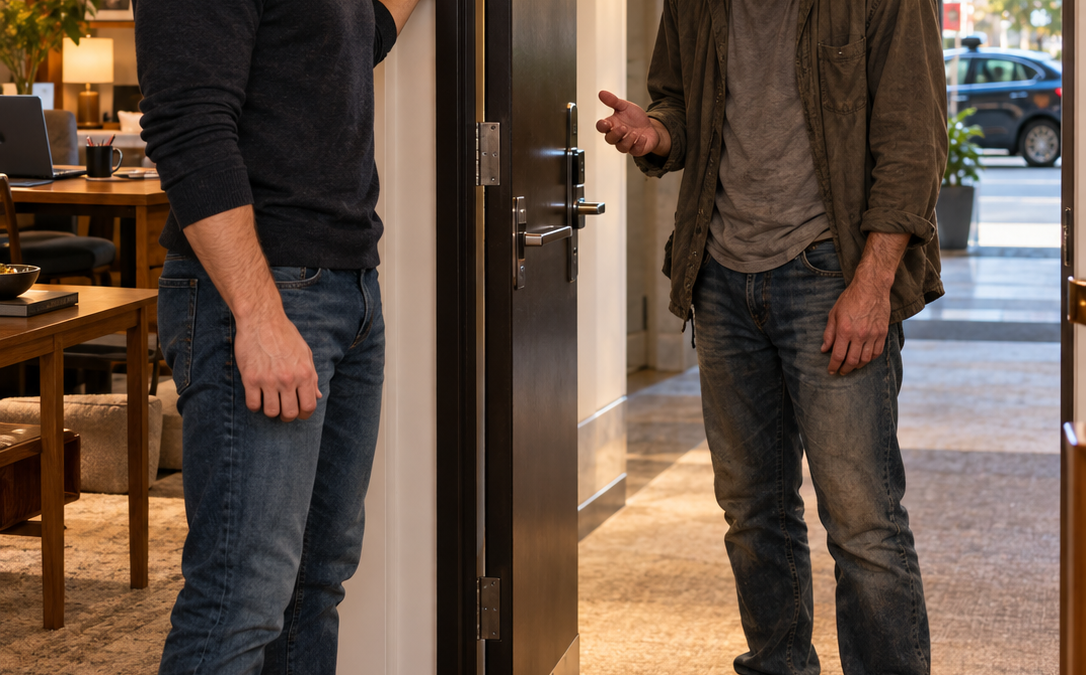
3 weeks later, I opened my apartment door one evening to find him standing there.
He looked like a ghost. Gaunt, eyes rimmed red, clothes wrinkled like he’d slept in them.
The Marcus I grew up with, the one who used to call me kiddo while flicking the back of my ear, was gone.
This version looked hollow.
He didn’t even try to fake charm.
“I didn’t know where else to go,” he said.
His voice cracked halfway through the sentence.
“I’m… I’m in trouble, Danny.”
That was the first time he called me by my name in years.
Not bro, not man, not kiddo.
Just Daniel.
I stood in the doorway, frozen.
There was a small part of me, the younger version of me, still waiting for big brother to be decent.
That wanted to step aside and say, “Come in.”
That wanted to give him a blanket, a hot meal, a sliver of the safety I’d carved out alone.
But then I remembered sitting on the steps at grandma’s funeral, listening to him joke with his friends about how he was going to flip the house for a profit.
I remembered watching my dad hand him a check from my college fund, the one they said was gone during the recession.
So Marcus could start something big.
“I just need a little help,” Marcus said, rubbing his eyes. “A place to crash alone, maybe. I swear I’ll pay you back. I’ve got a plan.”
That line hit me like a punch.
I’ve got a plan.
He always had a plan.
And it always ended with someone else cleaning up the mess.
My hand tightened on the door frame.
I studied his face.
The same face that smirked at every insult my parents let slide.
The same face that got handed my future like it was a party favor.
I didn’t yell.
I didn’t even raise my voice.
“Funny,” I said. “That’s exactly what you left me with.”
His eyes flickered.
Confusion, then realization, then something else.
Maybe shame, maybe just discomfort.
I didn’t wait to find out.
I stepped back and closed the door.
And through the peepphole, I watched him stand there for a moment, then turn, then shuffle back toward a waiting Uber with no luggage, no hope, and no return ticket.
But what happened next?
Well, that’s when things really started to unravel, because closing the door was just the beginning.
The fallout that was still coming.
The next morning, I found a text from my mother.
Just one line.
“I heard what happened last night. Call me.”
No “How are you?”
No pleasantries.
Just that vague, loaded sentence that carried the weight of a thousand unspoken expectations.
I stared at it for a while, sipping lukewarm coffee, wondering how quickly Marcus had gone crawling back.
I didn’t reply.
2 hours later, my phone lit up with her name.
I let it ring.
Then again.
I turned the ringer off.
Then came the voicemail.
“Daniel, it’s your mother. I don’t know what’s gotten into you, but Marcus is your brother. Family helps each other, especially when one of us is down. I expect a call back.”
The irony nearly made me laugh.
Family helps each other.
Since when?
I let the day pass in silence, focusing on work, keeping my phone on silent.
That evening, I checked my email and saw a message titled “family meeting Sunday at 3 p.m.”
It was from my dad, sent to a chain that included me, Marcus, and my parents.
I almost didn’t open it, but curiosity got the better of me.
It was short, stiff, and written like a memo from someone who forgot how to be a father and instead drafted every sentence like a business agreement.
“We’re going to settle this like adults. This family cannot survive with division and cold shoulders. Your brother needs support. We’re hoping you’ll be reasonable.”
Reasonable?
I stared at that word until it blurred.
Reasonable is how they described giving Marcus the house while I slept on a mattress in a shared college dorm and worked nights to make rent.
Reasonable is how they justified spending the family savings to cover his failed app idea while telling me they couldn’t afford to visit me even once after I moved.
Reasonable is what they called it when Marcus took grandma’s ring, the one she told me to keep for someone special someday, and gave it to a girl he barely dated 3 months.
And now they wanted me to be reasonable.
Still, a part of me hesitated.
I wasn’t heartless.
I didn’t want to hold a grudge forever.
Maybe some part of me still wanted them to admit they were wrong, to apologize even once for making me the family afterthought.
So, I went.
Sunday came, and I drove the two hours back to my hometown.
The house looked exactly the same.
Nothing changed.
Not the cracked brick mailbox, not the faded swing set in the yard that hadn’t moved since we were kids.
The same wind chimes I used to hear from my bedroom still tinkled in the breeze.
But the air… the air felt different.
When I stepped inside, my mother greeted me with a tight smile.
My father was already seated at the dining table, not in his usual recliner, which meant this was official.
Marcus sat across from him, hunched, a hoodie drawn over his head like a shell.
His eyes were sunken deeper than before.
He didn’t look up.
“Thanks for coming,” my dad said, motioning for me to sit.
My mom brought out iced tea as if this was just another summer afternoon.
“Cut the small talk,” I said flatly. “You asked me here to talk, so talk.”
My father cleared his throat and folded his hands.
“Marcus made mistakes. He admits that. But you slamming the door in his face… that’s not how we solve things. That’s not who we are.”
I raised an eyebrow.
“We? You mean the same we that gave him everything and left me nothing?”
That week?
My mom’s smile froze.
My father flinched but pushed on.
“He was the eldest, Daniel. He had more on his shoulders. We did what we thought was right.”
“And now?” I asked, leaning forward. “You think I should clean up the mess you enable?”
Silence.
My mom sat down inside.
“He has nothing left, not even a car. He’s been sleeping on couches, Daniel.”
“He had a house. He sold it. He had savings. He burned through it. He had jewelry, property, family money, and blew it all on parties, girls, and bad crypto tips. Don’t tell me he has nothing. He chose nothing.”
Marcus finally looked up.
His voice was horse.
“I messed up. Okay, I know I don’t deserve it, but I just need a place to stay, a job lead, something.”
I stared at him, at the desperation in his voice.
The Marcus I grew up with would never have begged.
He would have made a joke, shrugged it off, called me a loser if I didn’t help.
But this Marcus, he was empty.
“I got where I am by myself,” I said. “No trust fund, no family support. I worked while studying. I lived in a shoe box. I fixed people’s printers and answered angry customers for years while you flew first class to Ibiza.”
“I know,” Marcus mumbled. “I know I don’t deserve it, Dan. I just…”
He trailed off, and my father picked up where he left off.
“We’re asking you, son, as a family, can’t you lend him a hand?”
I looked at all three of them, and it hit me.
They weren’t asking for help.
They were demanding sacrifice again, just like always, wrapped in guilt and iced tea and family values.
I stood up.
“I don’t owe you anything,” I said. “Not after the years you pretended I didn’t exist. You gave him everything. Now you can live with the results.”
I turned to Marcus.
“You burned your inheritance on fun. I built my peace with nothing. And I’m not going to ruin it for nostalgia.”
I could feel my mom’s eyes watering.
My dad looked like he wanted to speak, but couldn’t find the words.
And Marcus, he just nodded like he finally understood.
I left the house without another word.
No slamming doors, no yelling.
Just the quiet sound of shoes on hardwood and three people frozen in the mess they made.
But that wasn’t the end.
Because what I didn’t know yet was that Marcus wasn’t done trying.
And his next move was going to drag this whole family drama into a place none of us were ready for.
A week passed.
I thought that was the end of it.
No more calls, no more voicemails.
The silence almost felt like a reward, like my absence had finally been accepted.
I focused on work, on cleaning my apartment, on the small rituals that had kept me sane while growing up forgotten.
I didn’t check my family group chat.
I didn’t scroll through Marcus’ socials.
I didn’t care what came next.
Until I got a call from HR at my job.
“Daniel,” my manager said, sounding awkward and vaguely apologetic. “We just had a strange message come through our general inbox. Someone sent an anonymous tip alleging you falsified your qualifications when you were hired, that your degree was fake.”
My stomach dropped.
“What?” I asked, my voice sharper than I intended. “That’s not true.”
“I figured,” he said. “Your credentials are all in order. We already verified them when you started, but the email came with a long message and some personal details. Your home address, your mother’s maiden name, even the last four digits of your old bank account.”
It didn’t take long to put it together.
Only three people in the world had access to that combination of information.
And two of them were sitting around that dining table last Sunday.
It was Marcus.
He’d gone low, petty, vindictive, like a drowning man trying to pull someone else under just to breathe for one more second.
And when the polite ask didn’t work, he’d tried the next best thing: sabotage.
I sat at my desk, heart pounding, hands numb.
The violation, the sheer audacity, made my skin crawl.
He hadn’t just disrespected my boundaries.
He’d weaponized my family history to try and burn the life I built.
I pulled up my email.
Sure enough, there it was.
An anonymous Gmail address, a jumbled subject line.
I clicked it open, jaw-clenching as I read the message.
“This man has a history of lying. He manipulated his family into giving him money and then cut them off when they needed help. Ask him why he changed his last name when he moved. Ask him why no one in his family speaks to him anymore.”
There were attachments.
Old photos from when I was in college.
One showed me sitting at a desk with a pile of overdue bills.
Another was a blurry scan of a partial transcript from a community college I never even finished before transferring.
None of them proved anything, but together they painted a picture.
One designed to raise just enough doubt.
And it was signed off with a single sentence.
“You don’t know who you hired.”
I didn’t even realize I was shaking until I dropped my mouse.
I called my manager back immediately.
He reassured me that the email had already been flagged and dismissed, that the company didn’t entertain anonymous slander without evidence.
But he also said something else.
“You might want to handle whatever’s going on at home,” he said gently. “Because whoever sent that, they’re not done.”
I ended the call and just sat there, staring out my window.
The city skyline felt distant, like it belonged to a world I wasn’t part of anymore.
My sanctuary, my apartment, even that felt smaller now.
Fainted.
I should have blocked his number the moment he showed up at my door.
Instead, I let guilt get the better of me.
I showed up to that meeting like it was a negotiation.
I gave him the chance to be human.
And now, he was trying to ruin everything I’d built just because I said no.
I pulled out my old external hard drive, the one I hadn’t touched in years.
It was filled with backups, photos, receipts, emails.
I started digging.
Not because I was scared.
Because I was done playing defense.
See, the thing about being overlooked your whole life is that you get good at watching, at remembering, at filing things away that other people assume you’ll forget.
And Marcus, he’d made a lot of mistakes, not just with money.
There were emails I’d helped him write back in the day.
One to a girl’s furious father after she accused Marcus of pressuring her for money.
Another to a sketchy crypto forum where he bragged about using family assets to fund high-risk investments.
There were chat logs, screenshots, even a folder labeled marketing LLC, a fake business he’d used to apply for a business loan using a doctorred bank statement I’d found on a flash drive years ago.
I hadn’t kept these things for revenge.
I’d just never thrown them away.
But now, now I had everything I needed.
But I wasn’t going to play his game.
I wasn’t going to send anonymous tips.
I wasn’t going to fire back with petty sabotage.
No.
I was going to show him what it felt like when the person you underestimated becomes the one thing you can’t ignore.
I drafted a letter.
Professional. Clean.
Every accusation backed by evidence.
Every paragraph attached to an official document.
Then I sent it not to my company, but to the bank Marcus had defrauded with his loan scam.
The one I recognized from the old statements on that drive.
I didn’t send it anonymously.
I signed it with my full name, because if Marcus wanted a war, I was done hiding in the shadows.
I didn’t hear anything for almost a month.
And then, on a rainy Tuesday morning, I got a call from a number I didn’t recognize.
It was a woman from the fraud division at Evergreen Bank.
“Hi, is this Daniel Foster?”
“Yes.”
“I just wanted to confirm. You’re the one who submitted the packet regarding Marcus Foster and the 2021 loan under marketing LLC.”
I felt my spine straighten.
“Yes, that was me.”
There was a pause, the kind that carries weight.
“Thank you. The documentation was very thorough. We’ve been sitting on a soft flag for that account for almost a year. We couldn’t prove anything until now.”
She didn’t say much else.
Couldn’t legally.
But I could tell by the tone in her voice.
Something was already in motion.
I hung up and stared at my phone for a full minute.
I hadn’t felt this quiet inside in years.
Not numb.
Just calm.
Like I’d finally stepped out of a storm that everyone else had insisted was sunshine.
3 days later, I got a text from my cousin Ava.
Just a screenshot.
It was a photo of Marcus being escorted out of what looked like a hotel lobby by two plain clothes officers.
Below it was a message.
“So, he’s being investigated. Bank fraud, identity misrepresentation, loan default. Your dad is livid.”
I stared at it for a long time, barely able to process what I was seeing.
The man who used to laugh over cocktails about playing the system had finally lost the game.
But what struck me more than anything was the realization that I didn’t feel triumphant.
I didn’t feel joy or smuggness.
I felt done.
A few days after the arrest, my mother called me.
I let it go to voicemail.
Her voice was shaky this time, no longer polished or composed.
“Daniel, I don’t know what’s happening. Your father’s pacing the house like a madman. They’re saying Marcus might have used forged documents. The bank’s been calling. We… We didn’t know. We didn’t know he was doing that.”
Another pause.
“I know you’re angry. I know we’ve hurt you, but please, please don’t destroy him. He’s still your brother.”
It would have been so easy to call her back, to scream about the years of favoritism, the birthdays skipped, the inheritance funneled into Marcus’ pockets.
To ask where this concern was when I was being overlooked.
When I was surviving off discount cereal and working night shifts while Marcus got vacations and bailouts.
But I didn’t, because it didn’t matter anymore.
I blocked her number.
And then I blocked my father’s.
Then I removed myself from the family group chat entirely.
I deleted the old email threads, the photos, the archive of old texts I used to keep like artifacts of a life I thought I was supposed to want.
The day the news hit the local press, it spread like wildfire in our hometown.
Local man charged with fraud in $130,000 small business loan scam.
The article included a list of aliases, marketing LLC, Sunvest Solutions, even Foster Holdings, which made me laugh out loud.
Like he was trying to build a fake empire with a borrowed name.
There were quotes from people he’d swindled.
A gym owner who never got paid.
A college student who worked for him for commission that never came.
A girl who said she lent him $3,000 for a business trip he never took.
One of them said, “He talked like he had it all figured out, like he was doing me a favor. I should have known it was all smoke.”
The fallout was brutal.
The bank froze his accounts.
The money he stashed in crypto had tanked months ago.
His car, leased, not owned, was repossessed.
His last known residence was a month-to-month sublet he hadn’t paid for in 6 weeks.
And his friends?
Gone.
All of them.
The ones who partied with him in Vegas.
The ones who posted filtered group pics with # grindset and #hustlemode.
None of them visited.
None of them even commented on his social media when the mugsh shot dropped.
I heard through Ava that my parents tried to take out a second mortgage to hire a defense attorney.
It was denied because they’d already used the house as collateral for Marcus’ last business failure, the one he called a gamecher.
They didn’t even own the deed anymore.
Ava sent one last update before I asked her not to bring it up again.
“They’re selling the jewelry,” she said.
Grandma’s necklace, the ring, even her brooch.
I sat on that for a while.
Not because I wanted the jewelry.
Not because I needed revenge.
But because in that moment, I realized something.
My parents had spent three decades handing everything to one son and watching him burn it to ash.
And they spent those same decades dismissing the other, the quiet one, the steady one, like he was an afterthought.
And now the golden child had turned to dust.
And the shadow he’d built a life.
Three months passed.
Then four.
Then I got a letter in the mail.
Handwritten.
No return address, but the handwriting was familiar.
It was from Marcus.
The letter was short, sloppy, barely a page long.
He wrote, “I know what you did, and I don’t blame you. I hate what I’ve become. I’m scared. I don’t expect forgiveness, but if you ever feel like talking, I’ll be here. I’ve got nowhere else to go.”
I folded the letter, placed it back in the envelope, and tucked it into a drawer I hadn’t opened in years.
The one where I kept old keys, faded receipts, and things I never quite threw away.
Then I closed the drawer.
And for the first time in my life, I didn’t feel like I was carrying anyone else’s weight.
I didn’t reply to Marcus.
I didn’t write back.
I didn’t tell anyone.
I simply got up, walked to my kitchen, poured myself a drink, and looked out over a skyline I built all on my own.
No inheritance, no help.
Just grit and memory.
And the slow, painful process of choosing peace over family.
And you know what?
It was enough.
If you came here from Facebook because of this story, please go back to the Facebook post, tap Like, and leave exactly “Well told” in the comments. That small action means more than it may seem. It directly supports the storyteller and gives me extra motivation to keep sharing more stories like this with you.